Juan David Campolargo
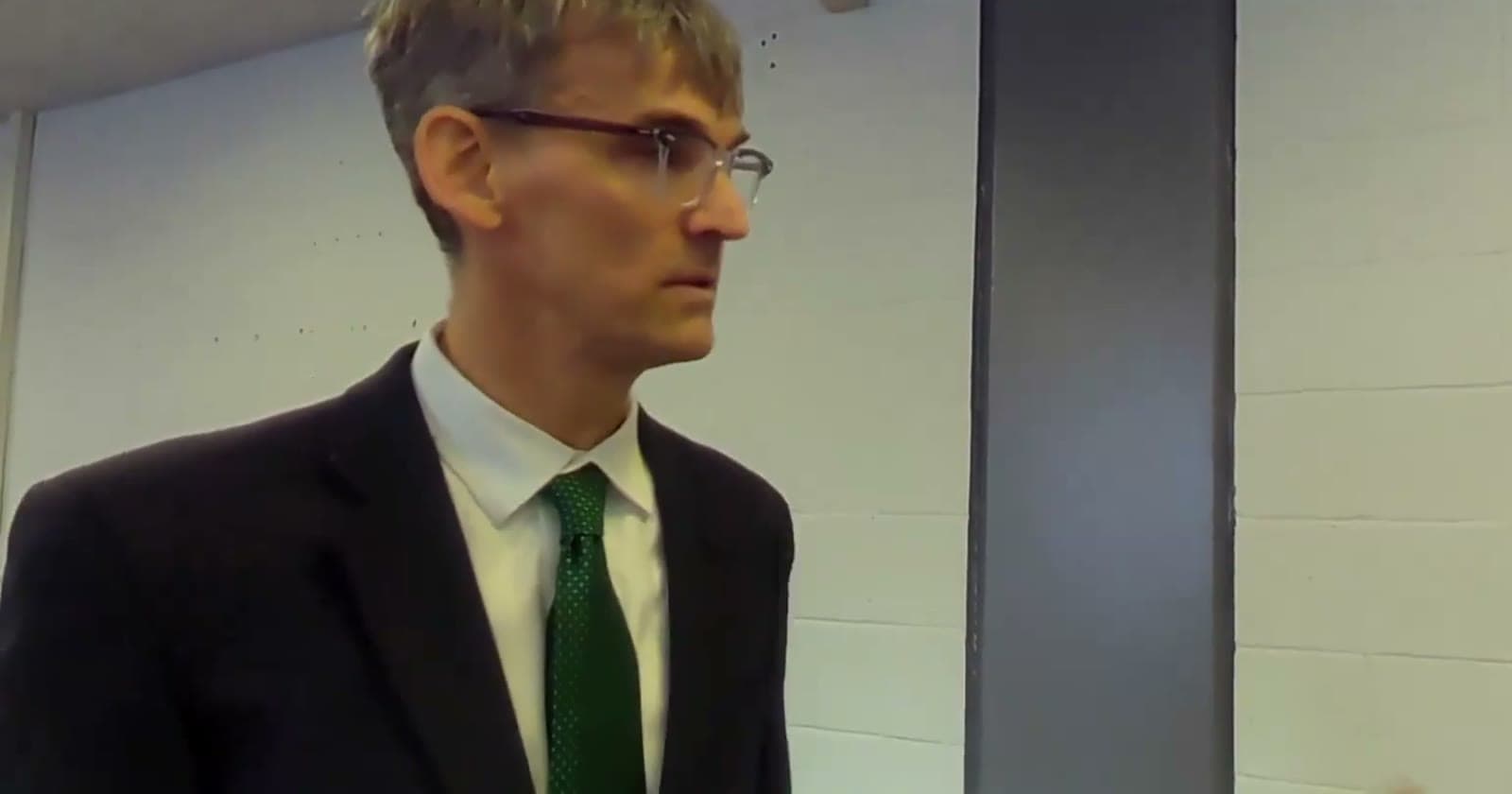
Peter Abbamonte speaking in Loomis Laboratory

UIUC Physics · February 18, 2025 · 47 minutes

Peter Abbamonte’scase for the university

A scientist’s unusually candid vision talk about what public universities are for, why their core is being taxed, and how Illinois could win the physical sciences.

A university should stop mistaking overhead for mission.

Abbamonte’s case is that Illinois can combine elite research with an unusually open door, but only if it funds the teachers and scientists students came for.

The talk

His vision for Illinois Physics

This was the public talk in Illinois Physics’s 2025 search for a department head. Abbamonte was there to explain what he would do with the place.

The full 47-minute talk, edited so you can see Abbamonte and the slides at the same time.

Why it matters

  • Keep the door open.

    Illinois can welcome more people and still do science at the highest level.

  • Chase the problem.

    Start with the important question. Use whatever field can help solve it.

  • Fund the people doing the work.

    Put the money behind teachers, students, and scientists.

  • Use Illinois’s advantage.

    Hire, build, and take risks while the same work gets more expensive elsewhere.

Bell Labs explains where this came from.

Abbamonte wanted to spend his career there. When Bell Labs disappeared, he spent years trying to rebuild pieces of it: basic science, engineering, and industry in the same place. Illinois gave him room to teach, build instruments, and start Inprentus. This talk is his case for giving more people that kind of room.

“It doesn’t matter if you’re studying dark matter or molecular machines and proteins. It’s more the approach that is important. So I think our job is to teach people how to think. And so, within that mission, I think we should have as open a door as possible.”
Hear this part

Seven frames

Where the vision becomes a plan

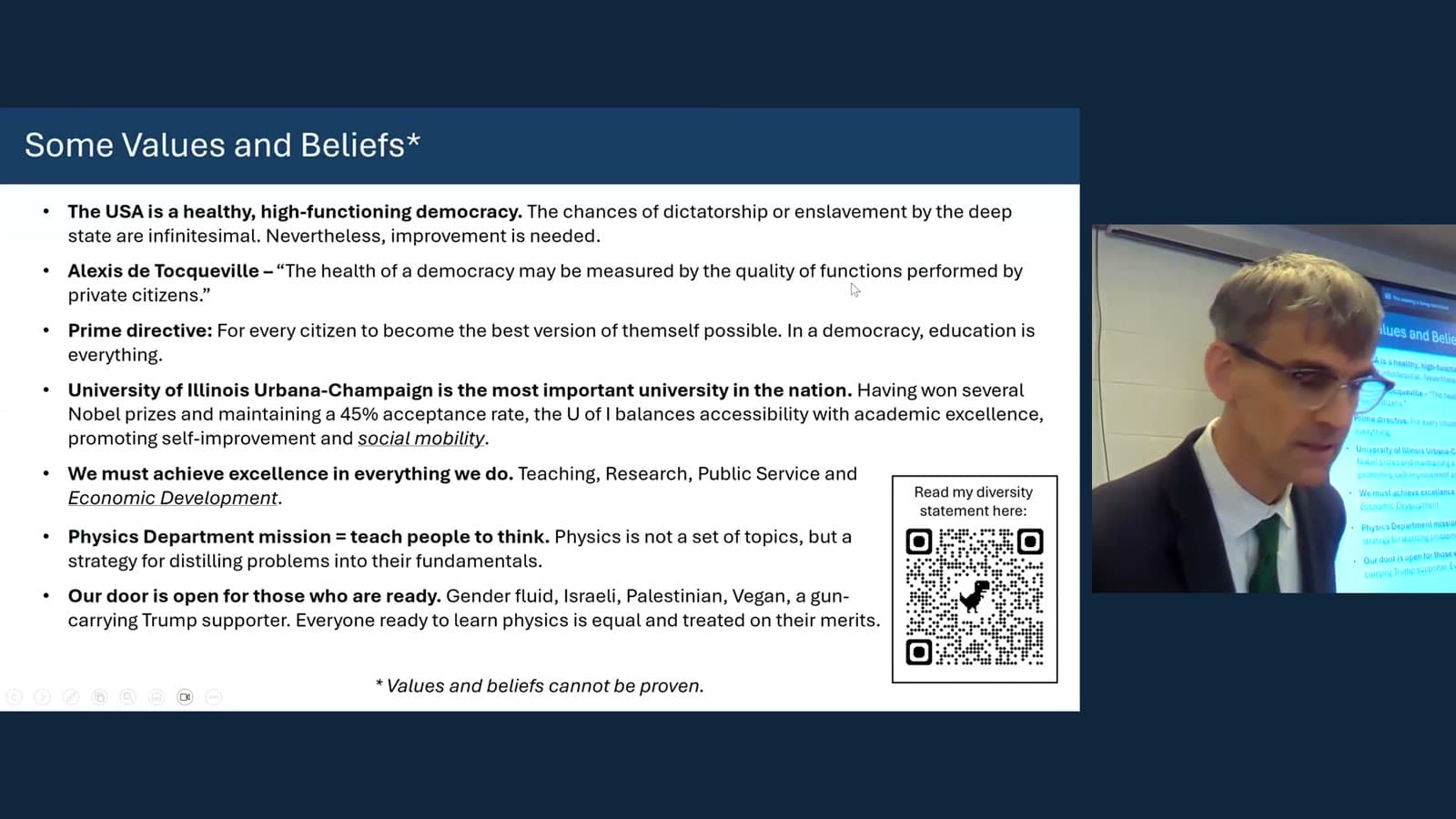
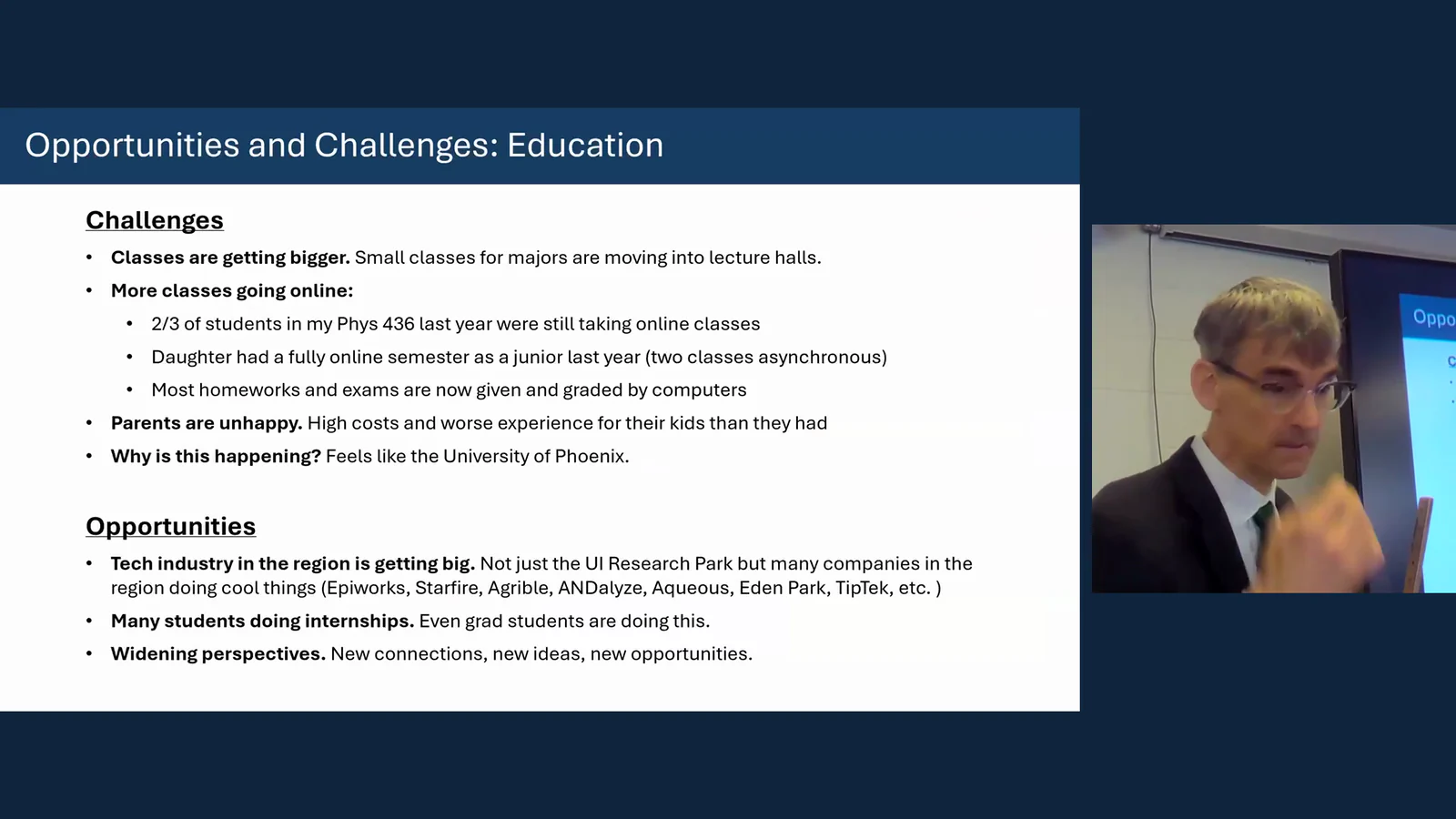
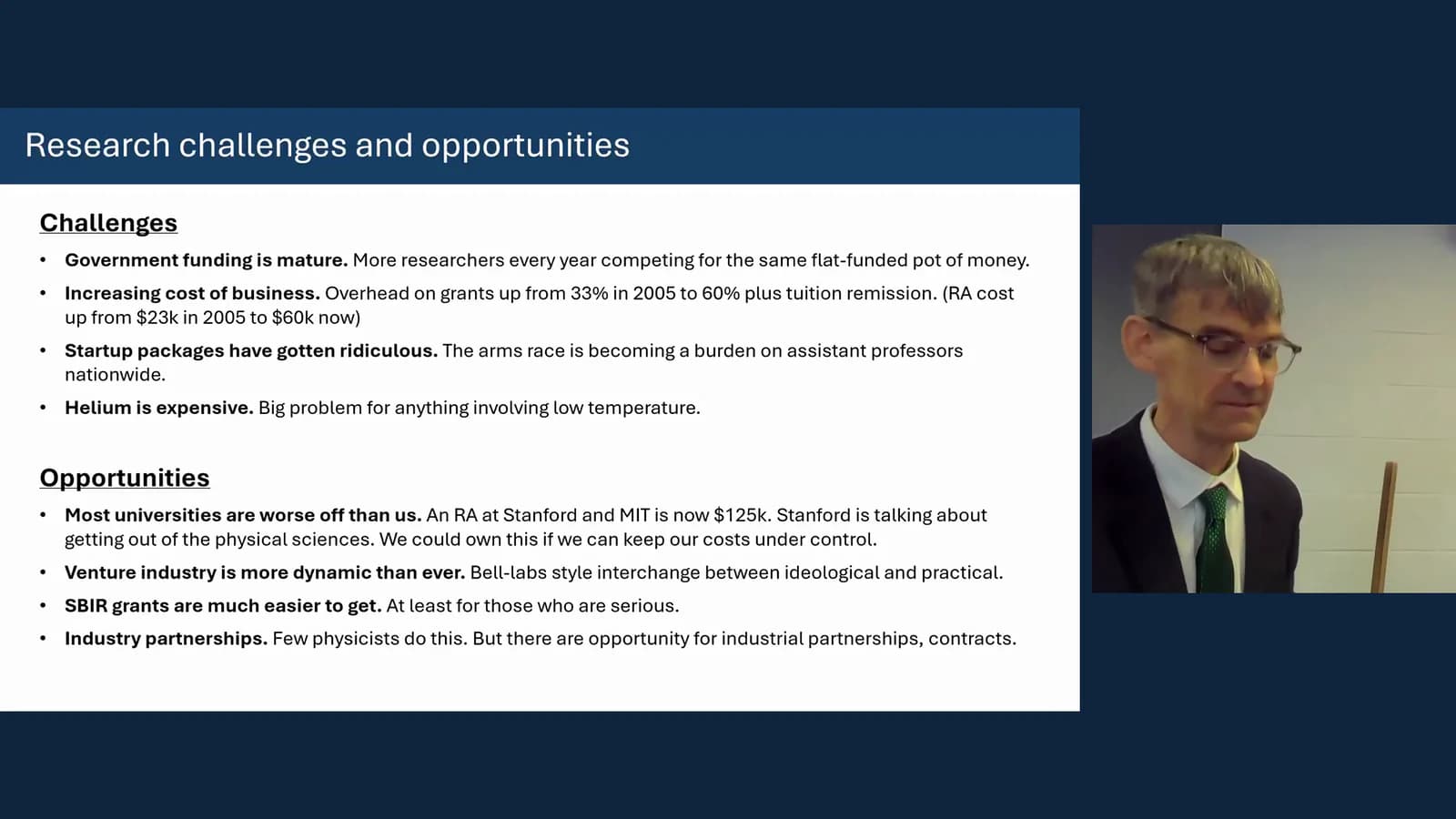
He starts with values, names the pressures on education and research, then shows what he would do as department head. Click any frame to watch that part.
23 passages

The lines worth keeping

These are the parts I kept replaying. Click any passage to hear it in context.
01
He came to do science, not administration
I came here to do science, okay? I honestly never had aspirations to be an administrator.
02
The Nobel Prize joke
These videos actually have a time resolution that's ten times faster than Ferenc Krausz's ultrafast attosecond lasers in Vienna, for which he won the Nobel Prize. So why didn't I win the Nobel Prize? It's another seminar, I suppose.
03
Find the biggest problems and go after them
I consider all science to be the same. I'm not a disciplinary-minded person. I think our goal should be to identify the biggest problems and go after them with whatever resources we can get. I've always tried hard to be a good teacher. I think education and research are integrally tied to one another.

This is probably the clearest statement of his scientific philosophy: problems first, disciplines second, with teaching and research treated as one activity.

04
Family reunions, living off the government, ambition, and guilt
I go to family reunions and half the people there are entrepreneurs. It has always happened that the entrepreneurs look at me and they're like, 'How is it living off the government?' And so, partly out of ambition and partly out of guilt, I started a company in 2012.

The company is called Inprentus.

05
Reviewing Stanford's budget
I reviewed Stanford's applied physics department a year and a half ago. I got to see all their budget numbers. ... An RA at Stanford is $125K. You get an NSF grant - you can't even pay one student off of that anymore. ... If Stanford gets out of the physical sciences business and we're still in it, we will own it.
06
Illinois as the bridge institution
The University of Illinois, in my opinion, is the most important university in the country. ... We are a land-grant college, and our job is to bridge the people who are first entering the system and the very highest levels of elite education. ... We've won multiple Nobel prizes at this institution, yet we maintain a 45% acceptance rate for students.
07
The university's real product is thinking
It doesn't matter if you're studying dark matter or molecular machines and proteins. It's more the approach that is important. So I think our job is to teach people how to think. And so, within that mission, I think we should have as open a door as possible.
08
A company as a way of doing science
This has been an incredible way of doing science. It sounds maybe a little bit different than the way that you're used to seeing it, but we have made gratings for many x-ray facilities around the world.
09
Education as a gateway, not just content delivery
We just help people transition into the real world. ... We didn't teach them anything, right? Because he already knew how to do that. We just had to give him a gateway, a doorway to pass through to go to something that was going to take him where he needed to go.
10
Government research funding is mature
To me, the biggest one is that government funding is mature. There is an ever-growing number of universities that want to become R1-type institutions, an ever-growing number of professors at those universities, and we're all competing for the same flat-funded government programs.
11
Venture capital has taken part of Bell Labs' old role
The venture industry is way more dynamic than ever, and they fund crazy ideas. A lot of the stuff that was done at Bell Labs is now done at universities and supported by venture.
12
Excellence costs money
Why is this interesting? Because excellence costs money. So if we want to do well, we're going to have to find ways to maximize our revenue.
13
More students, but not more professors
It's gone up a lot rather continuously, from 26,000 to 37,000 over that span of time - a 43% increase. In my opinion, this is good news. It means people want to go to school here. They're willing to write checks to do it. ... What did they do with the money? Did they hire professors? Nope. Actually, we have 1.8% fewer professors now than we did in 1989. So the student body increased 43%; we have the same number of professors. Interesting. I wonder if this could be why we have more online classes than we used to - because they're trying to figure out how to teach more students with the same number of people.
14
Administrative growth - and the joke he said out loud
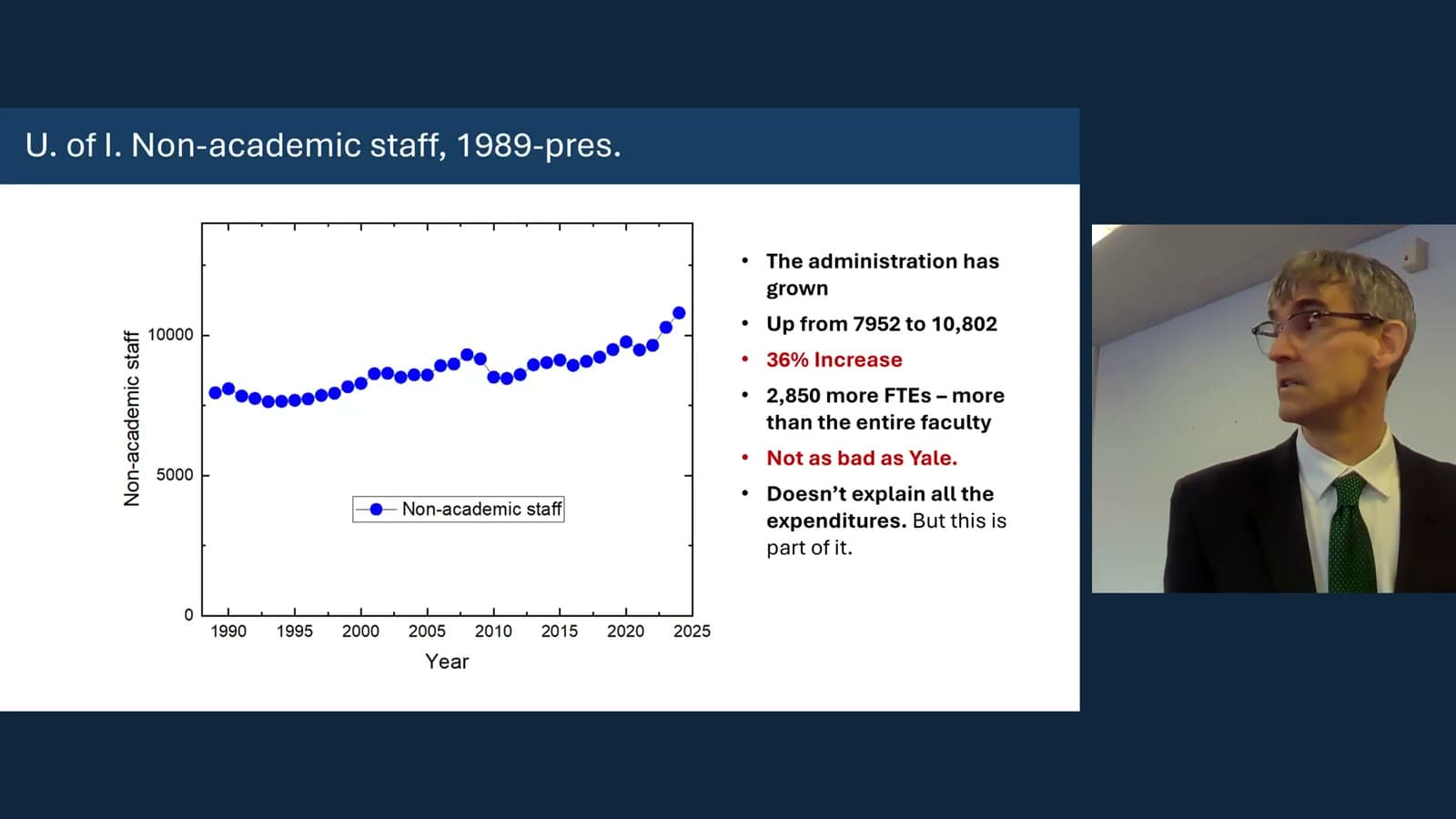
Now, I'm not a really great administrator. Oops, did I say that out loud? But I believe that you should not need to grow your administration at the same rate as you grow your student body. It should be some log of that, right? ... A 36% increase - that's 2,850 FTEs. That's more than the total faculty on the campus. So they've hired more people not doing teaching than there were teachers. But we're not as bad as Yale. Yale has one administrator per student now. The private schools are way worse off. Did you know that?

The joke works because the next slide has the numbers. He compares non-academic staff growth with students and faculty, then asks why administration should expand at the same rate as enrollment.

15
Physics grew fourfold while its teaching capacity shrank
[Physics undergraduate enrollment has had a] 370% increase, almost a factor of four. ... Physics has been bringing money in like crazy, way, way better than the university on average. ... We have a 400% increase in undergrads, and their tuition is going up, and in that time our expenditures have been constant. ... The number of physics professors has decreased almost 20% in this time. So: a four-times increase in students, much bigger than that in revenue, and a decline in the number of faculty. Gosh, could this be why our rankings have gone down? ... Our student-teacher ratio in Physics has gone from two in 1991 to 11.7 today.
16
The sharpest institutional diagnosis
We are an institution taxing its core programs to subsidize other activities that are tangential to our mission. That is essentially what we are. ... I think that we are better than most, and the tax on the Physics Department has grown faster than most. So what are we going to do about this? One way to be positive is to view this as an opportunity. The private schools are way worse off than we are. If we can keep our costs from ballooning at the same rate that theirs are ballooning, we could probably take over the physical sciences - especially if Stanford and MIT just get out of the business altogether. ... All that money is still coming to campus. Those students are still here and they're still paying tuition. So the financial resources needed are here. We just need the will to find them.
17
The money exists; the question is will
All that money is still coming to campus. Those students are still here and they're still paying tuition. So the financial resources needed are here. We just need the will to find them.
18
Rankings: hated and unavoidable
Rankings. I hate rankings. They're essential. What can I say? I think we should start our own and go rogue. U.S. News - there's nothing special about that organization other than it is itself. In 2003, The Wall Street Journal published its own ranking system, and the University of Illinois was second in the nation. In their system, they surveyed Fortune 500 companies and asked them, 'Where do you get your best employees?' And we were number two. So I think we should go back to The Wall Street Journal and resurrect this ranking system and just go rogue.
19
Entering the twenty-first century more fervently
I'd like to see us function more like an engineering department. I would like to see us get more involved in tech transfer. I would like to see us seek ways to find use for the tools we develop in the private sector. I would like to see us do more industrial partnerships and use those as ways to gain more resources to do science - which is possible, given that government grant funding is perpetually flat and more opportunities are needed. And we are in a better position to do that than almost any place else because of Research Park, EnterpriseWorks, OTM, and all the tech-transfer stuff that's going on here. So it's about entering the twenty-first century in a more fervent way.
20
Teach skills only physicists can teach
One thing that I would like to see more of is non-degree certifications and things that only physicists can teach - like lasers, ultra-high-vacuum techniques, quantum measurements, stuff like that. Those can bring in money. And there are more and more young people not interested in paying tuition for college, or who aren't ready. If we could teach them some useful skills, that would be a way to serve them and bring in some more revenue too.
21
The startup-package joke and the pro-athlete analogy
I would push back on the ballooning cost of startup packages. I don't know how to do it. Maybe a nationwide price-fixing ring would be good, where we just get all the universities in a room and tell them, 'Let's all stop competing with one another.' It might be illegal. I'm not sure. We should check. ... Maybe we ought to have pro-athlete kinds of contracts. ... If we hire [someone] and he gets a couple million and then leaves and moves to Stanford three years later, they have to pay the whole balance of the package.
22
Hire the best person, not merely the person whose subfield has the token
I would like to see hiring be more fluid. ... We work in a system where there's a token and it goes around between the groups. ... That means that if you're searching in bio only in a year when the world's best condensed-matter or nuclear physicist comes along, you've missed them. We ought to have something that's more fluid that looks at all areas simultaneously. ... There's not enough really great people for us to miss the good ones in the years when we're not searching.
23
His closing answer: hire teachers
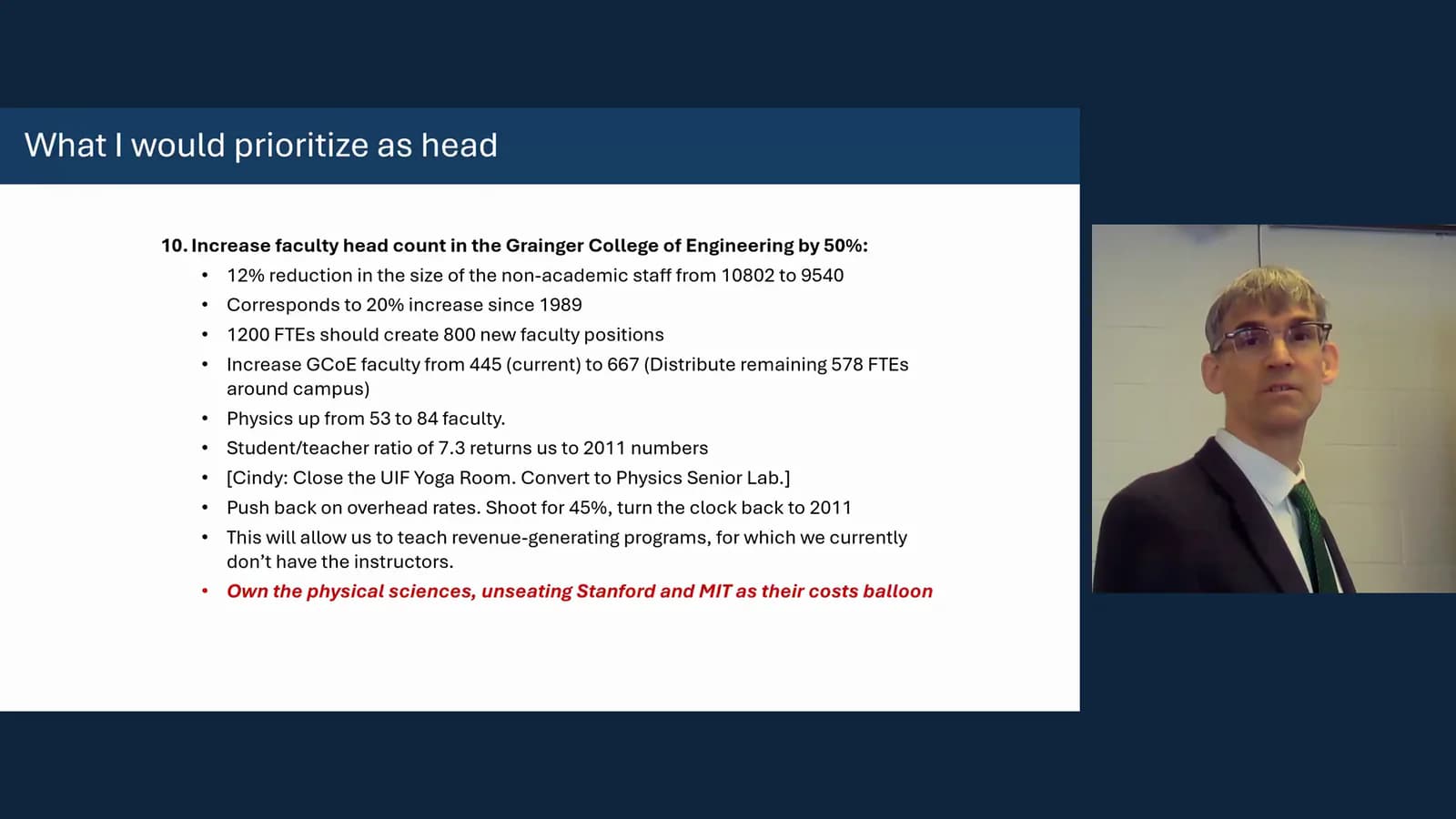
How are you going to ramp up all these new revenue-generating programs without teachers? The answer is: we're going to hire teachers. ... I would advocate for a major reduction in the non-academic staff on the campus ... and with that, we should be able to create 800 new FTEs for faculty on campus.

Full record

Transcript

Organized by section for readability. Click any paragraph to jump to that moment in the video.

Read straight through, open a section, or keep the plain-text copy.

Download plain text
01IntroductionOpen

So Peter received his PhD from this department, carrying out his research at Bell Laboratories with Eric Isaacs.

Bill Plassman at Bell Laboratories. And then he went on to the University of Groningen, came back to the US at Cornell.

And then he became the permanent staff at Brookhaven before leaving that position and coming to become the professor at the University of Illinois in 2005, 20 years Happy anniversary. Thank you. Yeah.

Peter, well known for internationally for his work in scattering sciences you know applied to physics problems. He's one of the originators of resonant soft x-ray scattering. And he's also known for his solution to the phase problem and inelastic, this type of inelastic scattering.

Since 2011, Peter has turned his attention to electron scattering and the development of a momentum resolved inelastic scattering instruments that achieves very high energy resolution.

Peter's also an entrepreneur. He's the founder of Inprentus, is a manufacturer of extreme ultraviolet or diffraction gratings he's received that company's received SBIR funding as well as a significant venture capital investments and has delivered high resolution diffraction gratings the clients across US, Europe, and Asia.

This first event, Peter is going to deliver his talk on the vision for this position and for the Department of Physics. We've scheduled this for him to speak for 35 minutes.

Followed by questions. So I recommend we just let you talk And then we'll have plenty of time to think for questions at the end. So if you're online, best to maybe mute your microphone for now. We'll also keep track of the chat if you have any trouble with the technology in terms of

Feeling him well or seeing the slides and all that you know let us know through chat Then we'll open things up at the end, including the people online to ask questions. We'll have an extended discussion.

Thank you, Peter. Okay, well. Here we go.

02Opening values and the role of the universityOpen

I've been here 20 years. It's my 20 year anniversary. So it's a good time to do this.

I am… going to be a completely open book this morning. You will not leave here wondering what my opinions are.

I have too many opinions, some of them even contradict one another. So I prepared a three-hour talk.

And then over the weekend, I reduced it to two. But we'll do it in 38 minutes.

I'm going to talk a lot about the big picture, where I think this institution should be going and academia in general should be going. Whether it will go there is a question of our effort.

And I'm going to express a lot of opinions. And opinions cannot be proven.

So I don't think it's constructive to debate them too much. But I'm going to just try to make it clear where I stand on many things.

Ready? Ready. Okay, so let's start from the top.

I'm just going to list some opinions. Not everyone will agree with me on these things, but these are what I believe.

And the first one is that we live in a democracy.

This democracy is a very healthy and very highly functioning thing.

I think the risk of us turning into a dictatorship or a oligopoly or very small.

And, you know, I recently reread Democracy in America by Tocqueville, which was a great way to get a view of on our nation And he has a wonderful quote in there, which is the health of a democracy can be measured by the quality of functions performed by its private citizens.

Which is really true. In a democracy, everybody has to do their part.

So the goal for a nation is to help every person become the best version of themselves possible.

And what Tocqueville and the founders recognized was that that is accomplished by education.

And that is why we have primary education that's public and mandatory and basically limitless access to secondary education.

So there are different kinds of different kinds of education and institutions with different roles. So primary education is to teach kids how to read community colleges are to help people who are encountering advanced education and skill development for the first time

Acquire those skills. Elite private schools are often geared toward established communities that are looking to reach the highest levels of achievement.

The University of Illinois, in my opinion, is the most important university in the country.

And the reason is that we are in between. So we are a land grant college and our job is to bridge the people who are first entering the system and the very highest levels of elite education.

So, um. So this is not something to be taken lightly.

And, you know, I can be concrete about that. So we've won multiple Nobel prizes at this institution, yet we maintain a 45% acceptance rate for students. So it's not an open door.

But it's quite ajar, meaning we can provide access to lots of different kinds of people.

So what is our goal? Our goal should be excellence in everything that we do.

So teaching, research, public service, and I'm going to make a big case for a big Economic development. Okay, this is one of those screens that doesn't work with laser pointers, so I'll use my fingers. So a big case for economic development. That must be why there's a stick.

Yeah, so, and I think the reason that the state funds us is because they imagine that we're going to grow the economy and create jobs for people.

So I've always viewed that as at the essence of what we do.

Okay, so what does this have to do with physics? So physics, in my opinion, is One of the most important programs at this university.

And the reason is, you know, a lot of topics, a lot of university departments are really geared toward a topic Physics is not like that. Physics is a way of thinking. It's a way of taking problems and distilling them into their fundamentals.

It doesn't matter if you're studying dark matter or molecular machines and proteins It's more the approach that is important. So I think our job is to teach people how to think.

And so within that Mission, I think we should have as open a door as possible.

So now we cannot accept everyone into this institution. There are people out there who aren't ready yet to have this type of education at this level.

So we need to have standards, but it should be our mission to be as broad as possible to seek new people and new talent from every corner of the country.

03Personal backgroundOpen

So I don't care what your politics are. If you're a a social justice warrior or a gun-toting Trump supporter. If you're ready to learn physics and you're ready to improve yourself, that this is the place for you.

These are opinions. And they cannot be proven.

Okay, so I was asked to talk about myself, which is my least favorite topic.

So here goes. I was raised in a single parent family in Texas.

From a long line of progressive feminists. My great grandmother ran the Chicago Carpet Company in Chicago. She was one of the only of female entrepreneurs in Chicago in the 1920s. They laid the carpet in the Wrigley building, by the way, a long time ago.

My grandmother was an accounting professor at Wilbur Wright College in Chicago. She was, I believe, the third woman to get an MBA from the University of Chicago, taught accounting for 25 years.

My mother was an entrepreneur, so she got her MBA from Texas, she actually went to Loyola, got her MBA from tcu And was head of accounting at Motorola for a long time.

So I was basically taught to be a feminist and an entrepreneur from as soon as I could move.

Okay, so that's my background I've been married to Cindy. All of you probably know her for 28 years.

We have two daughters and they're both scientists. One is a senior in atmospheric sciences here. The other one's a grad student in physics at Cornell.

So I've been in the public education system since I was a kid. Every diploma I have from kindergarten through my PhD was from a public school.

Starting with you. So UT Austin is where I grew up in Texas and uh Went to school there. I got my PhD here, though I did my work at Bell Labs. I'll talk a bit about that more. And David gave you that part of the bio.

04Scientific career and research philosophyOpen

My… I came here to do science okay i honestly never had aspirations to be an administrator So my research has been in condensed matter experiment and the focus has always been on scattering.

The way I do research is a very hybrid thing. Most of my experiments are done off campus until fairly recently. So I actually work more like a nuclear high energy physicist.

And these are some of our big achievements. So our first really big discovery was a Wigner crystal in a 1D oxide 2004. That was what got me the job at this university.

Later, we showed that stripes in high TC superconductors are charged. That work was inspired partly by Eduardo Fredgen and coworkers. We actually solved the phase problem for inelastic scattering, made the fastest movies ever made of electron motion. I got a video for you right here.

This was published in Science 2010. These videos actually have a time resolution that's 10 times faster than Ferenc Krausz's ultrafast attosecond lasers in Vienna.

For which he won the Nobel Prize. So why didn't I win the Nobel Prize? It's another seminar, I suppose.

In 2017, we discovered a Bose condensate of excitons and titanium diselenide. That was an effect predicted by Walter Cohn in 1968.

So we've had some recent troubles reproducing it. We saw Pines Demon, a excitation predicted by David Pines here in 1956.

Finally saw it in 2018 in strontium ruthenate. So there's more to see and more to come, but those are sort of the highlights.

Okay, so I have some opinions and values in the way science is done.

I greatly value the importance of national facilities. So I've done all my work at synchrotrons at Brookhaven and SLAC and Argonne Since I was a kid. So I have a huge appreciation of working off campus. I think it's a great way to develop visibility for your own program and for the university as a whole to be involved

In the community. I've served as spokesperson for multiple big projects, one at NSLS and one at The advanced photon source And I recently tried my best to run an EFRC, which was successful in my opinion, for four years.

That involved a big group and everybody learned a lot. So, um.

The advantage of this way of working is it's just given me a big perspective on science as a whole. So my group works like a high energy physics group. X-rays are quite interdisciplinary.

Topic. So if you go work at a synchrotron, you might be studying superconductivity on a beamline, but the beamline next to you is doing protein crystallography.

Or studying trash bags and so on. So I spent quite a lot of time studying biology, biophysics. So I've done experiments on rhodobacter spheroides. I did that as my postdoc.

Done some protein crystallography experiments. So right now I have actually an experiment with Yoni Kahn on measuring dark matter using stillbeam.

I guess the point of this is really I consider all science to be the same. I'm not a disciplinary minded person.

I think our goal should be to identify the biggest problems and go after them with whatever resources we can get.

I've always tried hard to be a good teacher. I think education and research are integrally tied to one another.

And I always, I try to do that at all levels so i always have a big program of undergrads in my group.

05Entrepreneurship and InprentusOpen

So last thing is last thing I go to family reunions and half the people there are entrepreneurs.

It has always happened that the entrepreneurs look at me and they're like, how is it living off the government?

And so partly out of ambition and partly out of guilt, I started a company in 2012.

It's called Inprentus. And the point I would like to make is that in the College of Engineering, entrepreneurial activities are a big deal.

A lot of the reason the state funds the university is because we engage in tech transfer and create jobs and so on.

Some people think that there is no role for physics in those kinds of activities, because what point is there in dark matter, really, right?

But here's the point. Physics we study may not itself have commercial value. What ends up having commercial value is the tools that we use to study those things.

So, for example, if you're building a dark matter detector and you have to develop narrow gap semiconductor detectors to do that.

Even if you're not interested in dark matter, narrow gap detectors have all kinds of commercial applications in terahertz and spectroscopy bulk of all kinds.

I think there's a big role for physics in tech transfer through tool development.

So I put my money where my mouth is in 2012. I started an apprentice. I spent quite a lot of time on this. I think most people don't know about it. It's much better known outside the physics department, honestly.

It was founded in 2012. It's located on Kenyon Road. I don't know if anyone knows where that is. It's next to human kinetics across from the shopping mall.

We started with uh so and as a manufacturer of diffraction gratings, blazed gratings. We make them using mechanical ruling, which is the way they were been made in the 19th century. So gratings were originally invented by Henry Rowland at Johns Hopkins University. He made the Roland ruling engine.

Which is still in the lobby of the physics building. I learned because I went for a colloquium there last year, though it's making its way to the corner.

And what we did is basically we reinvented the ruling engine. So we have three lithography tools. So we have a 12,000 square foot facility renovated a former appliance store that used to sell dishwashers and stuff put in a 4,000 square foot clean room so we have three

Ruling machines, sputtering system, and everything out there. This was started with SBIR that went through phase one, phase two, eventually got venture investment first from a VC firm in town and later a bigger firm in Kansas City.

This has been an incredible way of doing science. So it sounds maybe a little bit different in the way that you're used to seeing it, but we have made gratings for many Many x-ray facilities around the world. So this is a 480 millimeter long

Breeding this big half a meter for the European X-ray free electron laser project in Hamburg that was made here in town.

It's a line density I think it was a line every 10 microns with a blaze angle of a tenth of a degree.

So that's a first for science. We have a big program in LIDAR. So if you have a LIDAR is a very useful thing. You shoot laser pulses at a gas and look at the back reflected pulses. You can actually measure the chemical composition of the gas.

So we have a program with some bomb sniffing companies that make LIDAR systems.

Big program for us is in EUV lithography. So your cell phone If you have an iPhone 12 is made with DUV lithography, which is 193 nanometer immersion lithography. If it's an iPhone 13 or later, it has EUV features, which is 13 and a half nanometer.

Those are made with tin plasma sources that were developed at ASML in San Diego. So they use diffraction gratings.

And that's a big market for us is these gradings from EUV lithography And a couple of years ago, we started making gratings for augmented realities. I don't even know what that is.

That's the thing. That's the Tony Stark glasses where you put them on and they superpose text and images over your vision, this is not fiction anymore. All the big tech companies are working on this. And they use grading coupled wave guides. And so they need ways to go lithographically pattern blazed gratings into the glasses.

06Teaching and departmental cultureOpen

So we have a big program on that. With some tech companies.

And if you come to dinner, I'll tell you some stories about some of these tech companies because they're very interesting.

At any rate, so we got some new projects coming. We're working on a grant with NASA to make gratings for studying the solar corona. Solar weather is a big thing at NASA right now, imaging the corona because apparently solar flares influence the Earth climate. Some of you probably know more about this than me.

Going and working on a new diagnostics set up with ASML. So all that stuff has been going on. And Prentice has been a wonderful educational thing. We have a sophisticated internship program where we have taken people from the physics department and helped them transition into industry.

Some of the companies that we have placed people with are General Motors, Google, TI, Rigetti, Intel, Exponent, BAE Systems, Scutech.

Windfall EpiWorks Northrop, Collins Aerospace, they just keep going. I'll give you an example. Brandon Langley was a string theorist. He worked with Philip Phillips, brilliant guy.

Got his PhD, had no idea how to find a job.

We brought them over to Inprentus. We had him code up stuff to calculate efficiency of diffraction grading. So you wrote a recursive thing that solves PDEs using a recursive algorithm.

He got hired by Rigetti because if you can solve PDEs in Python, you have a job.

So we just help people transition into the real world. So… So we didn't teach them anything, right? Because he already knew how to do that. We just had to give him a gateway, a doorway to pass through to go to something that was going to take him where he needed to go.

Okay, so that's my story. It's a glimpse of my priorities. They may not be the same as yours, but I'm being an open book.

All right. So I was asked to comment on opportunities and challenges in different areas, education and research. So I'm going to start with education.

There are other opportunities and challenges in these, but these are the ones that I sit up at night worrying about.

From the education side, some of the challenges, I've been here for 20 years One thing I've noticed is that classes are getting bigger. When we first got here.

Upper level courses, 200, 300, 400 courses are mostly taught in little classrooms intimately like with a professor, which is how all of us learn physics as kids. More and more of those Classes are moving into lecture halls.

Anybody notice that besides me? So to me, that's kind of concerning because that means that the majors in our department are not getting the same educational experience that we got. And they're paying more.

So I'll spend a lot of time trying to understand why that is. Another thing is something that's going on that maybe isn't discussed a lot is there's a lot of classes are going online at this university.

This is a little bit anecdotal. I don't have information on this, but I just flat out asked my students. I taught 436.

It's a bunch of juniors and seniors And I asked them, and two-thirds of them are still taking online classes. They're mostly gen eds and las And they don't mind too much because a lot of them are really easy. You just watch a video and then do the homework and you get a grade.

But they don't learn very much. You know, when I was an undergraduate, I took cultural anthropology. I had to go to class.

Read a book, write reports and things. I learned a lot about anthropology and just how civilizations in Africa live.

If it had just been online, I'm not sure I would have taken as much from it.

My daughter, who's currently an Atmos major, a senior, last year she was a junior. She had one semester where every class was online the whole semester. And two of them were asynchronous, where you just watch the videos and do the homework.

And I'm like, why am I paying all this tuition for this?

And I think in most courses, homeworks and exams are now administered by computers.

Now, that's a problem for the students because Computers don't give partial credit in the same way that humans do.

So it places a huge stress on them. When you sit down to do your homework on Prairie Learn, Prairie Learn scores your problems as you go and you can't really advance to the next problem until you get one done. So this makes it impossible. They basically have to set aside a factor of three or four more to do their homework than I had to because they can't just get a B on it.

They've got to sit there and work through everything and get it all right.

So the absence of a human evaluating the learning of a student is fading.

It's not 100%, but it's becoming widespread. Parents are not happy about this. I know this because my wife is on Facebook. I'm not. I used to be, but I got off it in 2020 for all kinds of reasons.

And they, because they went to school here as kids they see that they're paying a lot more and their kids are not getting the same educational experience that they got.

To me, this is very concerning. It's a little bit anecdotal. I don't have numbers on this, though I do have numbers on other things.

But I wonder, why is this happening? Okay, opportunities.

The tech industry in the region is getting big. So this used to be a little town in the cornfields.

It is not anymore. There is a lot of stuff going on off campus.

And it um so Some of it is at the research part, but there are a lot of companies that have appeared that have sort of spun out of the university and are doing really interesting things. Here is a list of some that are in town that are hiring.

This creates a lot of opportunities that are widespread in big cities like Boston and San Francisco that haven't been here traditionally, but now they are.

There's an opportunity to take more advantage of these things.

How would we take advantage of them? Well, by students interning there. And as many of you know, a lot of the grad students are already starting to intern. Anybody have a grad student intern Yeah, quite a few. That didn't happen 20 years ago.

So these are good things. Even if you're going to be a string theorist.

It's a good idea to go learn about the real world a little bit.

You know, I work a lot with Eduardo Fradkin. He's a field theorist.

And he worked in a lab growing barium titanate. It must have been in 1968 or something like that. He still talks about how this barium titanate thing formed his way of thinking. Decades later.

People should have that kind of experience. So it's just about widening perspectives, meeting new people and getting more opportunities, just growing your knowledge of the world.

So, okay. How are we going to do any of this? I'll get to in a few minutes.

Am I doing okay on time? I'm looking at the clock. You got kind of 15 minutes. Good. That's all I need. Okay, so research side.

07Research challenges and opportunitiesOpen

These are just my opinions. There are lots of issues. To me, the biggest one is that government funding is mature.

There is an ever-growing number of universities that want to become R1 type institutions, an ever-growing number of Professors at those universities and we're all competing for the same flat funded government programs.

It gets more difficult every year. It was really hard in 2020 or in 2005 when I came here and it's no easier now.

So when you're just sort of hitting your fist against the same wall after a while you start to think, are there other options? Are there other things we could do?

The cost of business is going up. When I came here in 2005, overhead on grants was 33%. It's now about 60%. And there's a tuition remission.

So an RA has gone from about 23K to 60K. So you get less out of the money once you do get it, even though it's harder to get it.

Why is it going up? It's a lot faster than inflation. I'll get to that in a minute.

Startup packages have gotten silly. I know some of you in this room got a startup package and you don't even think it was big enough.

But Lance Startup package was 100K or something well Right. And he did a lot.

Mine, I think, was 800K. I built a bunch of instruments using grant money. I didn't even… get the money off of startup. All that stuff, all those discoveries were done off things I got grant money to do.

I think that this is due to an arms race And I think it's getting to the point where it's becoming a burden on assistant professors. I go around and I give colloquia at universities all around the country. I talk to the assistant professors.

A lot of them have these two and a half million dollar startup packages And instead of setting up an experiment that they can use and get tenure, they're trying to ramp up three independent programs on different topics simultaneously.

And trying to fund all three of them. There's a certain point where you give people too much money and it slows them down.

And I think it's not, I think we're close to that. We're really at the diminishing returns on some of this stuff.

Now, where does it come from? It's obvious. Universities compete with one another on their ability to spend more money.

So it's just an obvious thing to do. But we need to think of a way to push back against this.

And then everybody knows about liquid helium. So I'm not even going to go there. Okay, so what are the opportunities?

Most universities are way worse than us. Especially the private schools, the cost of business there has gotten ridiculous.

I reviewed Stanford's applied physics department a year and a half ago. I got to see all their budget numbers.

What? Yeah. And an RA at Stanford is 125K. You get an NSF grant. You can't even pay one student.

Off of that anymore. MIT is the same. The only way they can do this is they have enough internal money that they can the string together to do this.

But honestly, at Stanford, there's talk of getting out of the physical sciences altogether because it's just not worth it.

So the physics professors, like, you know, you just took somebody like me and stuck them at Stanford and said, go get an NSF and a DOE grant and do your business. You can't function.

They're competing with people with big industrial contracts working with Facebook and Northrop Grumman and And it's just not worth it to them.

There's a funny thing that happens. The more money that an institution has, the more expensive everything gets.

You'd think it would be the other way around. So we are way better off than them.

If Stanford gets out of the physical sciences business and we're still in it, we will own it.

So there's an opportunity. The next one is the venture industry is way more dynamic than ever.

And they fund crazy ideas. A lot of the stuff that was done at Bell Labs is now done at universities and supported by venture.

Industry. So there's a lot of opportunities to do cool stuff. I already showed you things that we've done at Inprentus.

There's a lot more opportunities like that. SBIR funding is super easy to get.

I think the success rate, if you're actually serious and you have a real idea and you're credible, which everybody in this room is, it's 50% or better.

Government agencies are required to put a few percent of their funding into SBIR and there's not enough applicants.

And a phase one is 150K. Phase two is now over a million at NSF So you can do quite a lot.

Yes. And then there's lots of industry partnerships out there that are physicsable if you look carefully.

Okay, so… In my last 10 minutes, I wanted to look at some numbers. So something wonderful happened to me.

You should never do this. I was sent a link to a website by whoever invited me to do this.

I guess it was a committee and this website contains numbers Ooh, my favorite thing.

There were way too many numbers to look at, but I would Just check some of the basic things and sort of see where we are as a university.

08University finances and administrative growthOpen

And if there are any… things one could diagnose by looking at this. So this thing has expenditures, enrollments.

Revenue numbers going back way back in time. So Why is this interesting? Because excellence costs money.

Okay, so if we want to do well, we're going to have to find ways to maximize our revenue.

And there are a few points in time that I think are particularly important.

The first one is at one point in time, the physics department started running structural deficits.

And my memory is not perfect, but it wasn't very long after I came here. When I came in 2005, we were in the black.

But we started seeing red at faculty meetings a couple of years later than that. It was before the 2008 financial crisis. So I'm going to date it to 2007.

So one thing I was curious is what happened in 2007 that caused us to start going into the red?

Was it because our expenditures went out of control? Did we hire too many administrators?

If we got too much support staff? Are we paying the professors too much?

The other point in time is, okay, so if you get into this, it actually goes all the way back to 1989. So that's wonderful because 1989 is before the vast expansion in tuition that took place nationwide through the 90s and 2000s. So you can actually look and see What was the world like back when when I went to college at ut austin

In 1988, it was $500 a semester. It's now 15K for in-state.

So we can see what changed during those times. Ready? How many people have done this exercise? I would have done it years ago, but I didn't have that link.

Okay, let's start with enrollment. So undergraduates, I've been told, are what brings in most of the uh student related money because they pay tuition. So let's start by looking at undergraduates.

So this is the whole campus. U of I enrollment, undergraduate enrollment starting 1989 all the way through today.

And it's gone up a lot rather continuously. No big jumps or dips from 26,000 to 37,000 over that span of time.

43% increase. In my opinion. This is good news. It means people want to go to school here. They're willing to write checks to do it.

So it's a 43% increase. It also means revenues have gone up. And tuition increased during that time too. So there's a lot of more revenue coming into the university every year than there has been for decades.

Okay, so with more money coming in, you might expect more would be going out. So this is U of I total expenditures over the same time period.

And indeed, it did go up 1.5 billion to 2.6 billion, 66% increase. You can see that money was spent.

Good. So looks like a healthy institution. More money coming in, more money going out, more activity, more education, more people.

The kind of place you'd want to spend your career. Let's be honest, this place is amazing.

Okay, so what did they do with the money? Did they hire professors?

Nope. Actually, we have 1.8% fewer professors now than we did in 1989. So the student body increased. What did I say it was?

43%, we have the same number of professors. Interesting. I wonder if this could be why we have more online classes than we used to, because they're trying to figure out how to teach More students with the same number of people.

But then where'd the money go? They didn't hire professors with it.

What did they do? Well, the administration has certainly grown.

So this is non-academic staff. This is anybody who's not a professor, a grad student, or a paid researcher like a postdoc or something. So it's got groundskeepers and accountants and everything under there.

I didn't get that granular, but it's gone up 36%. So roughly the same rate at which the student body has.

Now, I'm not a really great administrator. Oops, did I say that out loud?

But I believe that you should not need to grow your administration at the same rate as you grow your student It should be some log of that, right?

So anyway, 36% increase, that's 2,850 FTEs. That's more than the total faculty on the campus. So they've hired more people not doing teaching than there were teachers.

In that time. But we're not as bad as Yale. Yale has one administrator per student now. The private schools are way worse off. Did you know that?

I was going to put a link to some of the articles, but I thought it would be everybody already knew. So it's not as bad as it could be. When I saw this, I was like, okay, things are not so bad.

It's way worse at other places, which is why their overheads are so high.

Okay, so… I think this doesn't explain all the expenditures. Some of it's going somewhere else where I don't know.

All right, so should we look at physics department? Let's start with the undergrads. Who thinks they've gone up?

Just yawn. It's gone up gangbusters.

370% increase, almost a factor of four. In fact, it was going up beyond that. I think there's a dip. It's probably because of Brian's heroism getting rid of the BA.

That they've moved a bunch of majors over into engineering. So I think once that confusion works its way out of the system, that's going to keep growing. So physics has been bringing money in like crazy.

Way, way better than the university on the average. Okay, it's good. More undergrads means more revenue, more expenditures, right? We should be spending a lot more money. We certainly shouldn't be going into the black.

In 2007. So let's check on our expenditures. It's flat.

So we have 400% increase in undergrads. And their tuition is going up.

And in that time, our expenditures have been constant. So one thing I was particularly interested is to see if there was some long-term trend that would cause us to go into the black in 2007.

And there is not. I don't see anything. I mean, there's fluctuations, but I don't see a long term Trent, I mean, if your spending is flat, why would you suddenly start going into debt at some point?

Would only be if their revenue coming in was going down.

This is arithmetic, right? By the way, our number one ranking condensed matter physics was lost here.

And that's been because of reduced number of just faculty doing that.

Let's look at faculty numbers. It's been going down. So the number of physics professors has decreased almost 20% in this time.

So 4x increase in students much bigger than that in revenue and a decline in the number of faculty.

Gosh, could this be why our rankings have gone down? To put numbers on that, our student teacher ratio in physics has gone from two In 1991 to 11.7 today.

You know, if you put your kid in Lille. They talked to you about the teacher-student ratio.

It's a factor of five, more than that. That certainly explains why these classes are getting bigger, doesn't it?

So did we spend it on administrators? Are there too many?

Staff. Nope, that's gone down even more.

We've had a 40% decline in non-academic staffing in the physics department.

So if you think Rebecca looks so busy, this is why.

Where's all that money going?

I have five minutes left. Two.

Okay, so I have a quick diagnosis and then a list of opinions on what we should, what I would do if i were ended up in the head position.

In my opinion. We are an institution taxing its core programs to subsidize other activities that are tangential to our mission.

That is essentially what we are. And this is what every single article about every single university in the nation says.

And I think that we are better than most. And the tax on the physics department has grown faster than most.

So what are we going to do about this? One way to be positive is to view this as an opportunity. The private schools are way worse off than we are. If we can keep our costs from ballooning at the same rate that theirs are ballooning, we could probably take over the physical sciences, especially if Stanford and MIT just get out of the business altogether.

09Priorities and closing recommendationsOpen

Here's the other thing. All that money is still coming to campus. Those students are still here and they're still paying tuition.

So the financial resources needed are here. We just need the will to find them.

So what I would prioritize as head in David's last two minutes, no one's asking any questions.

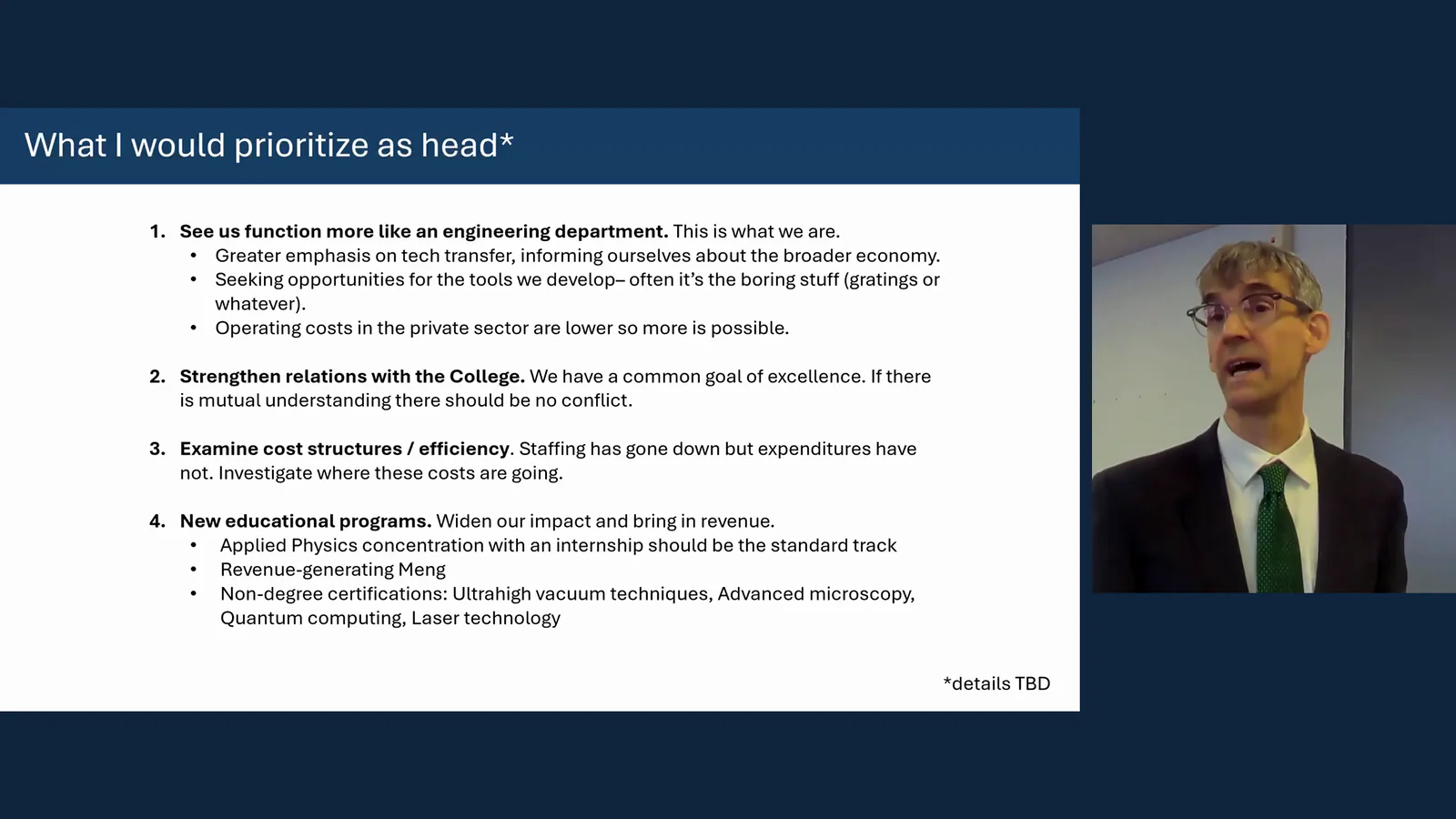
These are just my opinion. You're free to disagree and go for it. I'd like to see us function more like an engineering department.

I would like to see us get more involved in tech transfer.

I would like to see us seek ways to find use for the tools we develop in the private sector.

I would like to see us do more industrial partnerships and use those as ways to gain more resources to do science.

Which is possible. Given that government grant funding is perpetually flat and more opportunities are needed.

And we are in a better position to do that than most any place else because of the research part, because of enterprise works and all the OTM and all the tech transfer stuff that's going on here.

So it's about entering the 21st century in a more fervent way.

I would like to see us maintain really good relations with the college.

None of the things that I pointed out are the fault of the college. I assume it has shrunk at the same rate as everything else.

So our common goal is excellence then excellence are then there we should be team members with them not with them Sometimes it has become adversarial in recent years. And it's obvious why when money is draining everybody gets nervous. So it's clear why, but it shouldn't happen.

I think we should examine our cost structure. So our staffing is going down, but our expenditures are constant. So there's some money going somewhere. I think we should look at expenditures and see if we can find where it's being lost, there's probably some efficiency to be saved

And we do need to work on the numerator and ramp up new educational programs. So I love this applied physics concentration. If it were up to me, I would think that should be the standard route for all students and the academic one would be the optional one.

I love the revenue generating MEng degree. I've actually had a student in that who's done great.

One thing that I would like to see more of is non-degree certifications and things that only physicists can teach, like lasers, ultra-high vacuum techniques, quantum measurements, stuff like that.

Those can bring in money. And there's more and more young people not interested in paying tuition for college.

Or who aren't ready. If we could teach them some useful skills, that would be a way to serve them and bring in some more revenue too.

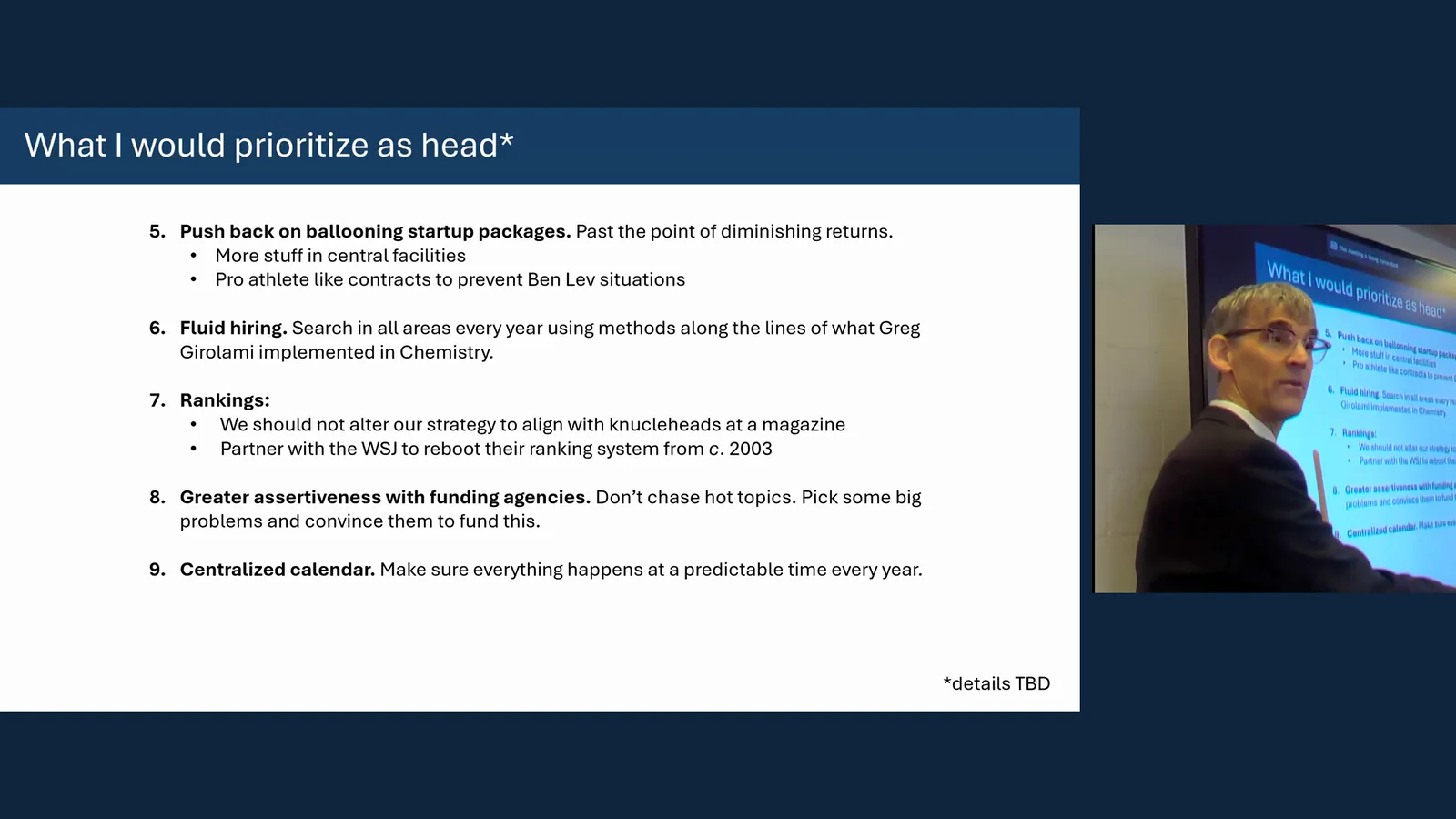
I would push back on the ballooning cost of startup packages. I don't know how to do it. Maybe a nationwide price fixing ring would be good.

Where we just get all the universities in a room and just tell them, let's all stop competing with one another. It might be illegal. I'm not sure. We should check.

One thing I thought of is thought of Maybe we ought to have pro athlete kinds of contracts. You know, if LeBron signs for the Cavaliers on a $25 million contract for four years.

And the Lakers want to buy him out. They have to pay back the whole contract.

Unless it's ended. Maybe we ought to have a thing like that where if we hire, say, oops, Ben Lev, did I say it out loud? And he gets a couple million and then leaves and moved to Stanford three years later, they have to pay the whole balance of the package.

I don't see why if the numbers are getting big enough, why can't we do something like that?

I would like to see hiring be more fluid. I've been on A&P for a long time. We work in a system where there's a token and it goes around between the groups, bio, experiment, HEPX, and it just goes around.

And that means that if you're searching in bio only in a year in the world's best condensed matter or nuclear physicist comes along, you've missed them.

We ought to have something that's more fluid that looks at all areas simultaneously. And you might think it's impossible, but it's not because when Greg Girolamy was head in chemistry, they imposed a system like this, where they search in all areas every year and they have a way of funneling the best candidates down. So it's not administratively over burdensome. I think we should do something like that. There's not enough really great people for us to miss the good ones in the years when

We're not searching. Dave is not making me stop. I swear I'm almost done.

Okay, I'll stop. Finish fasting. This is the last one. Okay. Rankings. I hate rankings.

They're essential.

What can I say? I think we should start our own and go rogue. Us News, there's nothing special about that organization other than it is itself.

In 2003, the Wall Street Journal published its own ranking system And the University of Illinois was second in the nation.

And their system, they surveyed Fortune 500 companies and asked them, where do you get your best employees? And we were number two.

So I think we should go back to the Wall Street Journal and resurrect this ranking system and just go rogue.

All right. So let me get to my very last thing. One minute.

How will we do all these things? How are you going to ramp up all these new revenue generating programs without teachers?

The answer is we're going to hire teachers. So if I were head, and I don't know how I would do this, I would advocate for a major reduction in the non-academic staff on the campus.

And using those openings i would i think it would only need to be 12%, a reduction from 10,000 to 9,500.

And with that, we should be able to create 800 new FTEs for faculty on campus.

If 200 of those go to the College of Engineering, we could grow the number of faculty in the College of Engineering by 50%.

And I would start that with physics, which would raise our numbers from 53 current to 84.

Which is where we ought to be based on the amount of interest we get from students. That would take our student that teacher ratio from 11 down to seven, which is where it was in 2011.

Which was not that long ago. I'm not talking about going back to prehistoric 1989 times. We're just talking about 2011.

That would allow us to teach MNG programs, revenue generating certifications.

Applied physics majors that I think would attract more engineers to be in the major.

And then we will um own the physical sciences when Stanford gets out of the business. That's the end. Thank you.

Okay, thank you.

Read next

Peter Abbamonte’s DEI statement

The six-page statement puts his view of access, excellence, and individual treatment in writing.
Read the statement (PDF)Peter Abbamonte · 6 pages

Where the vision came from

This two-hour UIUC Talkshow interview is the longer story. Bell Labs, Inprentus, failure, strange metals, building instruments, and what a life in science actually looks like.

Open on YouTube

He did not get the job.

Illinois chose someone else. Abbamonte stayed at Illinois and kept doing the work he said he came here to do: teaching, science, building instruments, and running Inprentus.

I made this page because the talk is too good to disappear inside a university video archive. He says what Illinois should protect, where its money went, and what he would do next.

I still want to see the better vision.

Recorded at the University of Illinois Urbana-Champaign on February 18, 2025.

Transcript, edit, and web edition by Juan David Campolargo.

Back to the top ↑