Real Estate is Algebra
Thoughts I had and things I learned while reading Risk Game: Self Portrait of an Entrepreneur by Francis Greenburger.
Personal
-
The book starts really personal. He describes his family history and what it was like to grow up in New York City. I found the first four chapters interesting and couldn’t put the book down. Why? He is transparent in a way that makes it compelling. He shares all sorts of things about his life, his girlfriends, first dates, the first time he made love, and running the bookkeeping for his dad’s literary agency.
- “Not only was I running my own business, but my duties at my father’s agency, which had expanded beyond bookkeeping, occupied quite a bit of my time. My move from the quiet sidelines of managing the finances to the middle of the action had happened about a year earlier, when I was fourteen years old.”
- He dropped out of his prestigious high school to focus on the book business and real estate.
-
His entrepreneurship story doesn’t start until chapter 5, but by then, you feel like you know him because he’s told you many revealing things that you just want more and more, so by the time he starts talking about his first business deals, you just trust him.
- One thought I had is, “Wow, what would his children or grandchildren think?” I mean, it doesn’t matter. It’s not like they haven’t had the same thoughts or feelings, but it’s interesting he chose this unfiltered confessional style. Though I don’t think it’s a style so much as a reflection of who he is.
Business
- His first real estate business came from renting office space and then dividing it up and leasing it by room. When he was 16, he rented a two-room office for his book businesses even though he only needed one room. He was paying $50 per room, and he subleased the extra room for $100, basically covering his entire rent. He realized there was a business there. A month later, he rented 7,500 sq. ft. of shitty walk-up office space, divided it into smaller offices, and rented each one separately to small businesses.
- How to find business opportunities? Focus on your own unmet needs.
- “Discovering an unmet need in the market is a tremendous start to any business. An effective way to find those opportunities hiding in plain sight is to consider one’s own experience. When, as a consumer, you find what you need is hard to source, that is a clue it could be a good business to start. Once I stumbled upon the need for one-room offices. I test-marketed the strategy by leasing one of my original offices. When I found someone willing to pay double what I had paid for a two-flight walk-up, I declared my concept a success and repeated the formula again, and again, and again.”
Real Estate
-
What was Francis Greenburger’s real estate strategy?
- First stage: repackage space
- Rent large or undesirable office space cheaply, divide it into smaller units, and rent those units for more.
- Second stage: stop renting buildings and start buying them
- But he almost never had enough cash, so a huge part of his real estate strategy became figuring out creative ways to finance the purchase.
- Third stage: co-oping
- Buy an apartment building and sell the apartments individually instead of valuing it only as one rental property.
- If selling roughly half the units could recover the cost of the whole building, the remaining apartments became the long-term upside.
- The individual pieces can be worth much more than the whole.
- Reminded me a little bit of private equity: buy something as one asset and create more value by breaking it into parts. For more on this, read Barbarians at the Gate or The Predators’ Ball.
- Overview: Change The Frame
- Francis found that the deals looked unattractive under their existing structure and the political and regulatory environment, so he changed the framing. A few examples include dividing large spaces into smaller ones, converting a low-income rent-regulated building into individual co-op apartments, and improving an expensive purchase through favorable/creative financing.
- A lot of the opportunity came from restrictions other investors hated.[1] In 1970s NYC, rents were regulated while costs kept rising, so many landlords wanted out, and buildings became extremely cheap. Francis bought into that mess and figured out a different way to make the buildings work (the co-op strategy).
- He tried to understand why something was cheap and then would figure out whether he could change the structure, financing, use, or regulatory economics enough to make it valuable. Francis approaches real estate like algebra: rearrange the variables until the deal works.[2]
- First stage: repackage space
-
How Greenburger finds value: “Value—something priced moderately with a good, definable reason why it will go up—can take many different forms.”
- Buy below replacement cost: “a building whose purchase price is inexpensive compared to its replacement costs.”
- Find locations before they catch up: “buildings that have extraordinary potential because of the changing nature of their location.”
- See a use or customer others miss: “I was filling a gap in the rental market for one-room offices”; elsewhere, he saw that “one could basically convert any Manhattan building, regardless of its character.”
- Buy vacancy at a price that accounts for it: “there is an opportunity to create value by building up the occupancy.”
- Make the numbers withstand scrutiny: “What works at one price doesn’t work at another”; “Vision without diligence is just an idea.”
- Joint-venture deals: Francis and Time Equities have built a good reputation so partners come to them with deals.[3]
Financing
-
Francis found several ways to fund his deals:
- Working cash: He opened overdraft accounts at six banks, giving him about $40,000 in credit for bills and repairs: “I could finally pay my bills when they were due.” He says those lines bought breathing room, not a long-term solution.
- Credit against his portfolio: A bank pooled roughly twenty co-op buildings into a credit facility, subject to loan-to-value limits. It grew into a $50 million line that could cover a building’s purchase price and fixed costs.
- Mortgages and construction loans: His usual purchase used a down payment and mortgage, with apartment-sale proceeds later paying off the debt.
- Seller financing: He sometimes had the seller hold part of the debt. One example: he bought two buildings for $75K. He got a $55K first mortgage from a bank and convinced the seller to give him a $20K second mortgage, which meant he “didn’t have to put any money down at all.”
- Investors and joint ventures: Investors could fund a down payment for a fixed return while he and an operating partner shared profits above it.
- Time in place of upfront cash: In his “stretch deals,” he offered as much as 50% above a normal buyer’s price if the seller waited roughly two years for payment. One example called for a $100,000 deposit on a $1.5 million price, with co-op sales expected to fund the balance. His formulation: “You can name the price if I can name the terms.” He also used a two-year option to pursue a conversion before committing to buy.
- Sales proceeds as financing: In his co-op model, selling roughly half the apartments to tenants could bring in enough to pay for the entire building; later vacancies provided additional upside.
- All cash when banks retreated: After the credit crisis, Time Equities bought properties lenders considered unfinanceable “entirely with our own equity (all cash),” leaving open the possibility of borrowing once operations improved.
-
I found wrap mortgages fascinating. I didn’t know about them. I’ll explain below.
- Let’s say you want to buy a property that already has a mortgage worth keeping. Maybe the seller has a 3% loan. Why pay that off just to replace it with a new loan at 7%?
- Another reason is that maybe a normal bank won’t lend to you yet because of your credit, income history, the property itself, etc. A wrap is basically creative financing that lets you get into the deal now, improve it, and refinance into a normal bank loan later.
- So what do you do?
- Find a seller who 1) has equity in the property, 2) has an existing mortgage with a low interest rate, and 3) prefers getting monthly income instead of all of their money at once. This could be for tax reasons, because they want the income, etc.
- Why do this? Well, a normal bank might not lend to you yet, or the seller’s existing mortgage might be too good to replace.
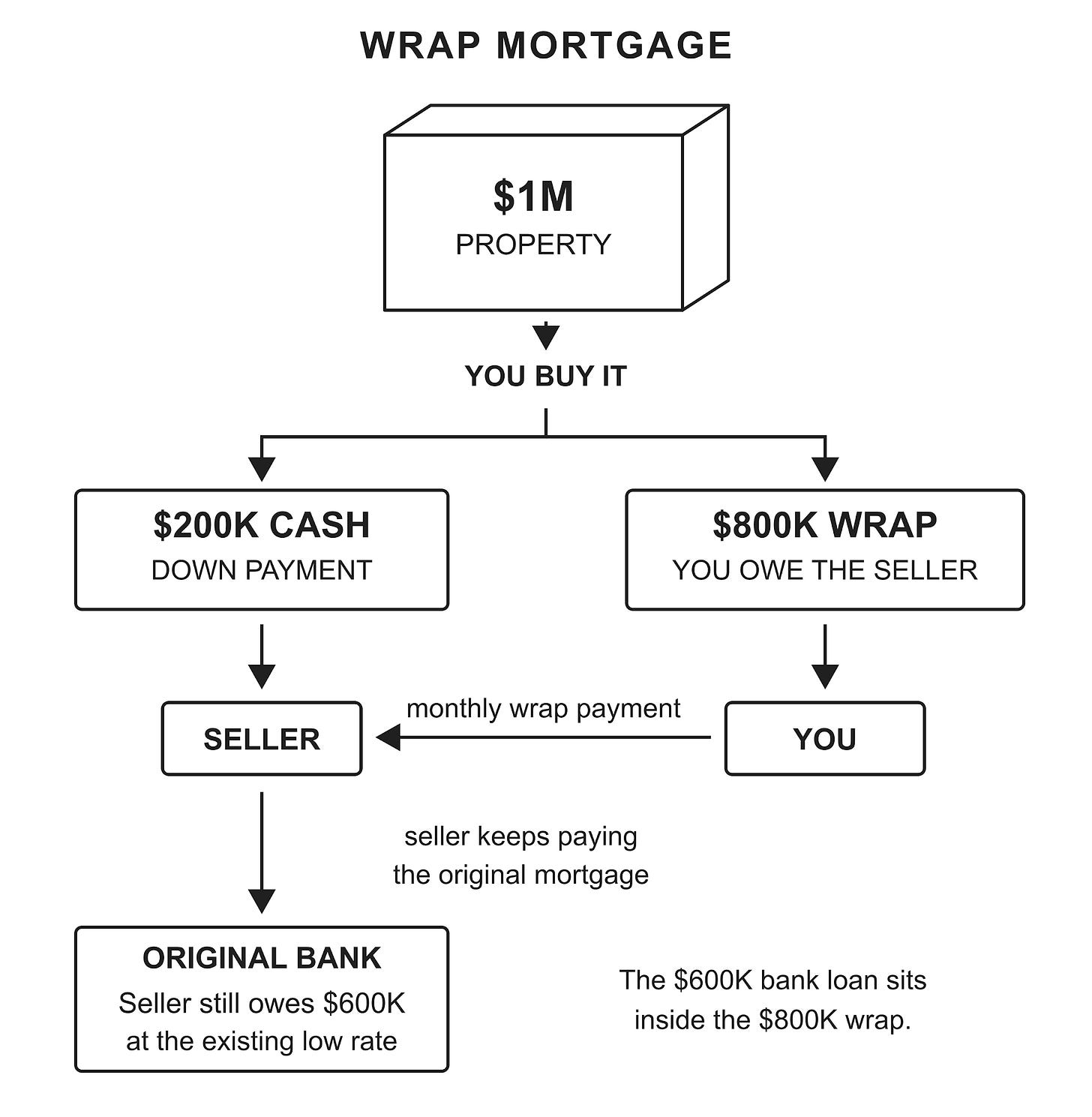
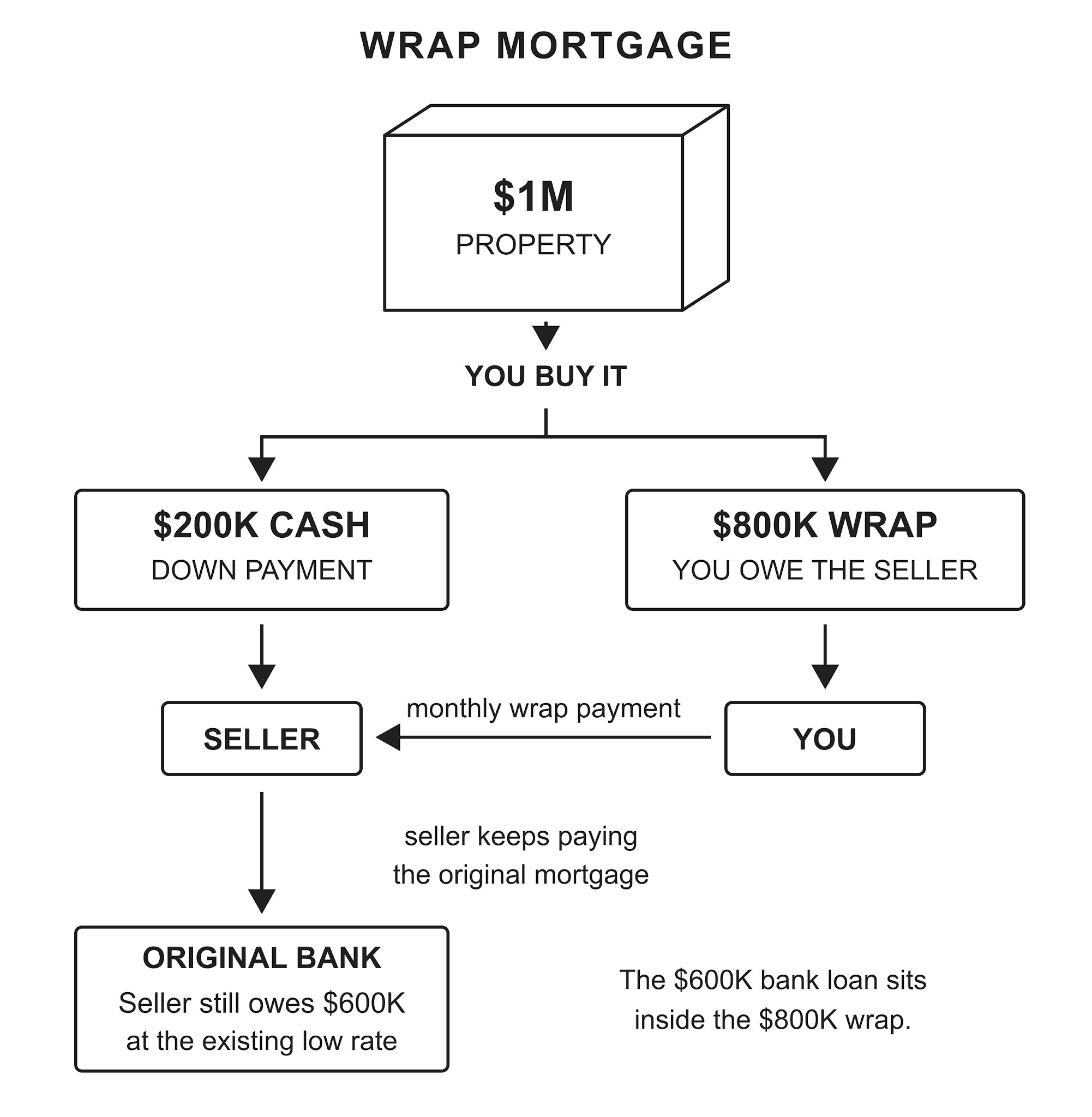
- Now assume the property is worth $1 million and the seller still owes $600,000 on his mortgage.
- You put $200,000 down.
- Instead of getting an $800K bank loan, the seller gives you an $800K wrap mortgage.
- You make payments on the $800K wrap mortgage, while the seller continues making payments on his existing $600K mortgage.
- The wrap mortgage might also have a balloon, depending on what you negotiate with the seller. The balloon is basically the deadline.[4]
- For example, the loan is amortized over 30 years but has a 5-year balloon.
- That means your monthly payments are calculated as if you were going to pay the loan over 30 years, which keeps the payment lower. But the seller doesn’t actually want to wait 30 years to get all his money, so after 5 years, whatever balance is still left becomes due immediately.
- So before year five, you need an exit: refinance, sell, or come up with the cash.
- That’s where the refinance comes in. By year five, hopefully the property is worth enough, produces enough income, and your remaining wrap balance is low enough that a new lender will give you enough money to pay the seller off completely.
- So basically:
- Buy using the wrap.
- Improve the property over the next few years.
- Refinance
- Use the new loan to pay off the seller.
- Now the seller is gone, and you just have the new mortgage.
- A few things:
- Once you get into the property, one of your main goals is to make the property more refinanceable.
- Renovations, better tenants, higher rents, lower expenses, better occupancy, better operating history, etc.
- In one sentence: increase the net operating income (NOI) and/or reduce the lender’s perceived risk.
- It’s like solving an algebra problem. You already know that in five years you’re going to need a lender to give you at least X dollars, so what needs to be true about the property’s value, NOI, DSCR (Debt-Service Coverage Ratio), LTV (Loan-to-Value), etc., for the bank to give you X?
- Of course, you don’t always have to refinance. You could sell the property before the balloon comes due, or you could somehow come up with the cash yourself.
- By the way, don’t assume appreciation will save you. If the property doesn’t go up enough—or interest rates go up, income drops, whatever—the bank might not lend you enough to pay off the balloon. Then you’re fucked and will have to come up with the difference yourself, sell, renegotiate with the seller, or potentially default.
- Before doing any of this, check the seller’s existing mortgage documents and lender. The existing mortgage may have a due-on-sale clause, meaning the lender could say, “You sold the property, pay us back now.” You can’t just assume the old mortgage can stay there because you and the seller agreed to it.
- Also, don’t just trust that because you’re paying the seller, the seller is paying the old mortgage. Imagine you make every payment perfectly, the seller pockets the money instead of paying his bank, and suddenly the property is in foreclosure. You’d want a proper third-party loan servicer and all of the payment mechanics, documents, insurance, taxes, and lender requirements properly set up.
- Once you get into the property, one of your main goals is to make the property more refinanceable.
-
Matt Levine once wrote that “the essence of finance is time travel.”
- How is that not one of the coolest things in the world? Finance lets you pull future value into the present. If people believe something will produce cash in the future, you can borrow against it, sell equity in it, guarantee it, lease it, securitize it, whatever, and use that money to build the thing today.
- AI financing is probably the most extreme modern example.
- For example, OpenAI can promise to buy billions of dollars of computers in the future. The company building that compute can then use OpenAI’s future payments to help borrow the money needed to build it today.
- Take CoreWeave. Under their original agreement, OpenAI agreed to pay CoreWeave up to about $11.9 billion through 2030 for compute. CoreWeave didn’t need to already have all the money required to build that infrastructure. The agreement specifically contemplated putting the infrastructure into an SPV that could borrow money to build it. So OpenAI promises billions of future payments. Lenders are willing to lend against those payments, which allows CoreWeave to get money today to build the computing infrastructure OpenAI will use tomorrow.
- If you know anyone involved in this kind of financial engineering at OpenAI, CoreWeave, Stargate, data centers, or similar companies, I’d love to talk to them!
- For example, OpenAI can promise to buy billions of dollars of computers in the future. The company building that compute can then use OpenAI’s future payments to help borrow the money needed to build it today.
- That’s what I find so interesting: you don’t necessarily need the money today if you can make the future credible enough that somebody else is willing to finance it. There are so many fascinating examples, including this story I wrote about this secret pandemic insurance policy.
- You just have to be creative. Find solutions where others see problems. Figure out how to finance the solution. Solve problems and make money.[5]
Philosophy
- “Independent thinking in its simplest form means not assuming that the status quo is the best answer, the right answer, or the most effective answer.”
- “Perceiving risk differently than other people is another way of creating value.”
- Conventional wisdom isn’t always wrong or, in fact, wrong at all under the frame most people are using. But conventional wisdom can be wrong if you change the frame, and that’s one way you can find more opportunities. You can be a contrarian, sure, but make sure you actually have a different frame and can see an opportunity. So don’t be contrarian just to be contrarian. Ask what assumptions make the conventional wisdom true. Then ask whether you can change one of those assumptions. A lot of opportunities are hiding there.
- “Alternative perspectives are crucial to being competitive in the marketplace (and they can come from anywhere, including seemingly insignificant voices). If you follow the mainstream, usually the margins are very small. You have to see things differently than the next person. If you discover something worthwhile, the market will reward you for your originality.”[6]
- When solving a problem, talk to the person who controls the solution to the problem.
- “Some try to cover up problems or manage them alone. Yet people often don’t think clearly about who controls the solution to a problem. If someone doesn’t have enough money to pay his rent, he will try to borrow money from family or get another loan from the bank instead of trying to negotiate a deal with his landlord. Identifying who controls the problem should be the first attempt in solving it. Then, what participation can you get from that entity or individual?”
- On mentors:
- Francis had lots of mentors in many areas such as real estate, arts, and philanthropy. Never did he ask someone to become his mentor.
- His mentors were all people whom he enjoyed talking to and appreciated their perspective. They would teach him something, and of course, the mentee can teach something, or at the very least listen and do things after talking to them.
- “I have always valued the importance of mentorship and credit a large part of my success to it. Yet at the start of each one of these relationships, I never thought of any of them as mentors. They were all just people who, at the time that I met them, I liked. And in turn, I don’t think any of them thought of me as their mentee—I was just someone they were willing to spend time with. Mentorship is like any other human relationship in that it involves respect, exchange, and chemistry. It is about friendship. Some of my mentors were famous in their respective worlds and others were not, but all of them gave me a wholly different perspective on their areas of expertise. As I evolved, I benefitted from their advice, encouragement, and introductions—like the one André made to one of his artists, Anthony Caro.”
One thing I wished the book had more of was details on the deals themselves, like financing, zoning, design, and how everything actually comes together. And it turns out Francis already wrote that book, called Autobiography of a Skyscraper: And the Story of Those Who Built It.
I’ve started reading it, and it reads almost like a journal, with enough detail to really see how these deals get done, how the zoning works, and how the different parts of a project come together. You also get to hear from the people actually working on it, including Francis, his joint venture partners, zoning lawyers, architects, and pretty much everyone involved. What a cool book!
If you’re into interesting ideas (like the one you just read), join my Updates, and I’ll send you new essays right when they come out.
Notes
[1] Will 2026-2030 be a good time to invest in NYC real estate?
[2] He could be a good physicist.
[3] “About 40 percent of the deals at my company, Time Equities, Inc., are joint ventures. Partners will often bring us local knowledge of the real estate market or access to a transaction. Often we complement them with not only money and bank credibility but also a full spectrum of skills and experience that come from more than fifty years in the real estate business.”
—Francis Greenburger & Rebecca Paley, Autobiography of a Skyscraper: And the Story of Those Who Built It.
[4] Why is it called a balloon?
Because the loan may have relatively small, regular payments for a period of time, but then a large lump-sum payment is due at the end.
The idea is that the final payment “swells up” like a balloon compared with the earlier payments.
For example:
- You borrow $300,000
- You make relatively small monthly payments for 5 or 7 years, depending on the terms of the balloon mortgage you negotiate.
- At the end, you might still owe $250,000. That remaining $250,000 is the balloon payment.
So the “balloon” refers to the large final payment, not the mortgage itself.
[5] Creativity in finance is just beautiful. Here are a few examples and quotes I think a lot about.
“…how finance could create something powerful from insight, courage, and imagination alone.”
—Juan David Campolargo, 3 Professors and a $24 Million Miracle
One of my favorite examples is the story of three professors at the University of Illinois who helped create an insurance policy against a collapse in tuition revenue from Chinese students. The university bought a three-year policy with a $61 million aggregate limit, including $36 million of pandemic coverage. The premium was about $424,000 per year.
Then COVID happened.
The policy ultimately paid the university just under $24 million.
They identified a risk that everyone could see but for which no normal insurance market really existed, and then helped create a financial product to protect against it.
I wrote more about the story here.
Another example is Michael Milken and the development of the junk-bond market at Drexel. Michael Lewis writes in Liar’s Poker that Milken persuaded investors that junk bonds could be a smart investment, much like Lewie Ranieri helped persuade investors that mortgage bonds could work.
“Michael Milken at Drexel created that market, by persuading investors that junk bonds were a smart bet, in much the same fashion that Lewie Ranieri persuaded investors mortgage bonds were a smart bet. Throughout the late 1970s and early 1980s Milken crisscrossed the nation and pounded on dinner tables until people began to listen to him. Mortgages and junk made it easier to borrow money for people and companies previously thought unworthy of the funds. Or, to put it the other way around, the new bonds made it possible for the first time for investors to lend money directly to homeowners and shaky companies. And the more investors lent, the more others owed. The consequent leverage is the most distinctive feature of our financial era.”
—Michael Lewis*, Liar’s Poker.*
[6] This, of course, reminds me of Ed Thorp and his book A Man for All Markets. His entire life and ability to make money were all about changing the frame and testing assumptions for himself.
Everyone knew you couldn’t beat roulette. And if you play roulette the normal way, they were basically right.
But Thorp changed the frame!!! Instead of treating roulette as a gambling game, he treated it as a physics problem: the ball has speed, the wheel has speed, friction slows them down, and maybe the “randomness” isn’t large enough to erase all of that information. He tested it and found an edge.
He continued doing the same thing with blackjack, and ultimately the stock market.
Thorp would tell you to always check things for yourself. That’s how you find faulty assumptions. He would always check everything for himself. A good example is the efficient market hypothesis.
“The market is efficient” was not something he was willing to simply accept. He tested the assumption, looked for where it broke down, and built strategies around those gaps.
“The market is efficient” was the theory. Thorp checked for himself and became quite wealthy a few years later. Beyond his wealth, he seems to have great health (and longevity), love, family, and overall contentment with his life.